
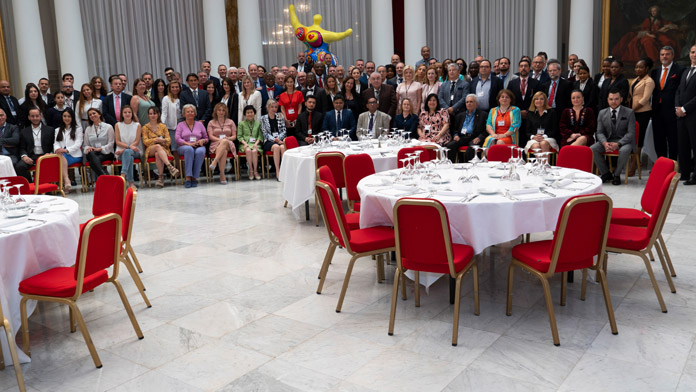
ACTUM Advocats joins as a member of the European Lawyers Association ACTUM Advocats joins as a member of the European Lawyers Association ACTUM Advocats, has been accepted as a member of the European Bar Association (AEA), a prestigious organization that represents more than 45,000 lawyers throughout Europe. The AEA is an organization non-profit that promotes collaboration and cooperation between lawyers from different European countries, encouraging transnational legal practice and the free movement of legal professionals in Europe< /strong>. The association offers its members a wide variety of resources and services, including continuing education, networking opportunities and access to a network of lawyers across the continent. The integration of ACTUM Advocats as a member of the AEA is a recognition of the quality of legal services and the commitment to international legal practice. The firm has a team of highly qualified lawyers with extensive experience in a wide variety of legal areas, including civil, criminal, commercial and employment law. Membership of the AEA will allow ACTUM Advocats to keep up with the latest trends and developments in European law, and offer its clients a broader and deeper perspective on legal issues that cover more of a country or jurisdiction. It will also provide the firm with a platform to collaborate with other European lawyers and firms and participate in AEA projects and committees that address cross-border legal issues. The integration of ACTUM Advocats as a member of the AEA is an important step in its professional trajectory and a testament to its dedication to excellence in legal practice. The firm is committed to maintaining its commitment to quality and innovation, and will continue to seek opportunities to improve its services and support clients in their legal needs.

law firm specializing in banking law
law firm specializing in banking law Why do you need a lawyer specializing in real estate and urban planning law for your neighborhood community? As a homeowner in a community of neighbors, it is likely that at some point you will find yourself in a situation where you need legal advice on matters related to real estate or the use of common areas. For this reason, it is important to have a lawyer specialized in real estate and urban planning law who can provide legal assistance to communities of neighbors. At our law firm in Girona, we offer legal assistance to communities of neighbors in all aspects of real estate and urban planning law. Our lawyers are highly qualified and have experience in the drafting and review of lease contracts, the resolution of conflicts related to the use and enjoyment of common properties, advice on matters of urban planning and planning, among others others Why is it important to have a lawyer specialized in real estate and urban planning law? First, a lawyer specializing in real estate and planning law can provide expert legal advice to the neighborhood community on complex property and urban planning issues, which are often difficult for those inexperienced in the field to understand. In addition, a lawyer specializing in real estate and planning law can help resolve conflicts between neighbors or between neighbors and the community of neighbors in general. Conflicts can arise due to the use of common areas, the payment of common expenses, the maintenance of the property, among others. In these cases, a lawyer specializing in real estate and planning law can intervene and find satisfactory solutions for all parties involved. In short, having a lawyer who specializes in real estate and planning law can be essential to ensure that communities of neighbors are well advised and legally protected in any situation. If you need legal assistance in real estate or urban planning matters, do not hesitate to contact our law firm in Girona. Our specialist lawyers will be happy to help you.

what are the steps to create a society in Catalonia
How to create a Society? How to create a Society? If you are interested in setting up a company in Catalonia, whether it is a limited liability company (SL) or a limited company (SA), there are several important steps that you must follow to ensure that everything is done correctly and in accordance with the law When taking the step and deciding to create a company, we may have many doubts about the procedures that need to be done, how long the procedure may take or what the costs of this operation may be. For this reason, it is important to take into account the following steps to anticipate the expenses, in time and money, that will need to be allocated before having the entity organized so that it can carry out its usual activity. These are some of the steps you need to follow: Choose the type of company Before starting the process of creating a company, you need to decide what type of company you want to create. The choice will depend on several factors, such as the number of partners you have, the responsibility they want to assume, the share capital they have, among others. Choose a name and do an availability search Once you’ve decided the type of company you want to create, you need to choose a name for it. It is important to check if this name is already registered and if it is possible to use it. To do this, you need to do an availability search in the Mercantile Registry. Draw the company statutes The articles of association are a document that establishes the rules and regulations for the company. They must be drawn up in accordance with the law and must be approved by the founding members. It is important that the bylaws are well drafted and clear to avoid future problems. Deposit the share capital The share capital is the sum that must be deposited in a bank account in the name of the newly created company. The amount of share capital will depend on the type of company that is created. Once the share capital has been deposited, a bank certificate must be obtained. Carry out the incorporation procedures After completing the above steps, the incorporation procedures must be done at the Mercantile Registry. These include submitting the necessary documents (statutes, bank certificate, etc.), paying the corresponding taxes and obtaining a tax identification number. Obtain the necessary licenses and permissions Depending on the type of business you are setting up, additional licenses and permits may be required to operate. For example, if it is a food business, health permits are required. It is important to obtain all necessary licenses and permits before starting operations. Sign up for Social Security Finally, it is necessary to register the company with the Social Security to obtain the corresponding affiliation number. This will allow the company to hire employees and meet its tax and labor obligations. In short, creating a company in Catalonia requires following several important steps. If you need help to create your company, it is advisable to contact our lawyers who are experts in creating companies in Girona. This way, you can ensure that everything is done correctly and in accordance with the law.

What should be done if a member of the community does not pay?
What should be done if a member of the community does not pay? One of the duties of vehicle owners in a community of neighbors is the payment of community fees for the maintenance and conservation of common areas. However, it can sometimes happen that some owners stop paying these fees, which can create tension and problems in the community. Prerequisites for judicial or extrajudicial claims If you find yourself in a situation where a vehicle in the community doesn’t pay, the first thing you have to do is check if the community has established internal statutes and rules that regulate this type of situation. If so, you will have to follow the instructions set out there. Otherwise, the Horizontal Property Law states that, in the event that an owner stops paying the community fees, these fees can be claimed in court along with the interest and expenses incurred. To do so, a previous claim must have been made through a burofax with proof of receipt. If the claim has no effect, you can go to court. As for the vehicle itself, the community cannot retain it or take actions that would violate the rights of the owner of the vehicle. However, a number of measures can be taken to pressure the owner to pay the dues. For example, the vehicle can be banned from the community, prevented from using the common areas, and even removed from the community if it is an item that takes up common parking spaces . It is important to remember that all these measures must be adopted in accordance with what is established by the statutes and rules of the community, and always respecting the rights of the owners. In short, if a vehicle in the community does not pay, the best thing to do is to follow the established legal procedures and, if necessary, go to court to claim the debts. Remember that it is always better to seek solutions through dialogue and peace before reaching extreme situations.

What rights do I have if I want to divorce in Girona?
Quins efectes té la negativa a sotmetre’s al test d’alcoholèmia? You will need a lawyer and a solicitor to act on your behalf. If both you and your partner agree to the divorce and all its terms, there should be no problem with both of you using the same lawyer. Your lawyer will be able to recommend a solicitor. Contact us at GironaAdvocats, to find out about our services. The Civil Code of Catalonia regulates three types of benefits that, after a divorce or separation, ex-spouses can request from each other. They are: the compensatory pension, the financial compensation due to work and alimony. Documentation necessary to process the divorce Together with your request for divorce, you will also have to present to the judge the proposal for a regulatory agreement, which will contain what they have jointly agreed on regarding the following points: The amount, if applicable, of the compensatory pension or alimony that one spouse must pay to the other. In the case of common children, the regime of coexistence and custody of them, including the visitation rights of the non-custodial parent. The amount to be paid for child support. Use of the family home. The form, if applicable, in which the spouses continue to contribute to family expenses. The marriage certificate and the birth certificates of the children. The power to approve the regulatory agreement and grant the divorce rests with the judge. 2) Contentious divorce It occurs when only one of the spouses requests a divorce without the consent of the other. The judicial procedure in these cases is longer and more complex and can last from a few months to more than a year. Necessary documentation Again, the divorce petition and proposed settlement agreement must be filed with the judge to request the divorce judgment, along with the marriage certificate and birth certificates of the children. If you and your spouse do not agree on the content of the governing agreement, your respective attorneys will have to negotiate with each other, perhaps also requiring third-party evidence. In the meantime, provisional measures can be adopted on issues covered by the regulatory agreement, such as child custody and alimony. Resources The judgment of the judge regarding the divorce sentence will be submitted to the Civil Registry of Girona, and can then be appealed. One or both spouses can request modifications of the sentence, which will be resolved by a subsequent judicial opinion. Custody of children Custody is attributed to the mother in most cases, especially when it comes to small children, with the exception of proving that it is not in the best interests of the child or children. Recently, Spanish courts increasingly support shared custody when both spouses wish to share visitation rights. Alimony Courts generally only award alimony in situations where one spouse will suffer a serious loss of income as a result of the divorce, for example, if they have given up a career to care for the children and the other spouse takes on the role of sole or main support of the family. The amount of alimony varies from one case to another, but it usually ranges between 15% and 40% of the wealthier spouse’s income. Division of goods Spanish legislation relating to the division of property in a divorce is determined by the local legislation of the couple’s place of residence. In Catalonia, Aragon, Navarre, the Balearic Islands and the Basque Country, for example, the Separation of Assets generally applies. This means that each member of the couple keeps everything they owned before the marriage, and any joint purchases during the marriage are divided based on each person’s investment in their acquisition. Court rulings also place an economic value on non-monetary contributions such as caring for the home and raising children. In the other Spanish regions, including Andalusia, the Society of Gains generally applies. This means that all property acquired during the marriage is considered to belong to both spouses equally, unless they are considered “private property”. Dual ownership applies to income from rentals, businesses, and property acquired with shared accounts or investments. Contact us Are you about to get a divorce or are you thinking about it? If you want GironaAdvocats, specialist divorce lawyers in Girona, to handle your divorce for you, or simply discuss r your options with us, you can contact us with complete confidence to arrange a consultation. We have offices in Vidreres, Girona.

How to know if the bank is charging me more
Quins efectes té la negativa a sotmetre’s al test d’alcoholèmia? The ones that never seem to lose money, even in times of crisis, are the banks. Banks offer what everyone wants: money! And the system is perverse, because if you take the money to the bank, your return can be zero, or very low compared to what is offered. But let’s go to the issue that really concerns us, as customers, to know if the bank is charging me more, if it is applying fictitious fees for maintenance, for overdrafts… It is true that banks have the power to set the prices they consider pos their services, due to the free market, however, there is a regulatory body which is the Bank of Spain, which acts precisely as a controlling element of banking activities, and there are certain regulated banking operations by current regulations. Many banks make significant profits by charging customers additional fees. These are often undisclosed fees that were never agreed upon by the consumer and may even include illegal fees for the bank. In some cases they may be charges for services that were never performed. Any banking entity in the Spanish State must comply with this law and not charge commissions to its customers for the operations, detailed below: Fees for cash income A common case we encounter with our clients is whether it is legal for our bank to charge us for a cash deposit in favor of a direct debit account on their records. These types of commissions, for transfers or income, are not providing service to the customer who makes the deposit, but to the owner of the account, the current jurisprudence has declared them illegal. Overdraft fee The rate that the bank makes us pay, for the loan that the bank gives us, to be able to meet a payment, when the balance of the account is insufficient. Is this type of fee legal or illegal? The answer is no, as long as they do not exceed the limits established by the Bank of Spain. Therefore, it is necessary to know or consult with the banking entity which interest on late payment is being applied to us. SEPA transfers outside Spain Just as no bank should charge us to send money from entity A to entity B in Spain, you should not be charged any kind of commission to send money to any other bank, by wire transfer, as long as it is located in the euro zone. Regulation 924/2009 establishes a principle of equality for transfers of up to 50,000 euros in the SEPA zone. Consult with a banking mediator or take the matter to court Finally, if the bank mediator fails to reach an agreement on the abusive bank charges, there is still the judicial conciliator (which can be taken to the nearest district court) or the district court. Usually, the customer who goes to this extreme does so for a large sum. Another way to challenge abusive bank fees is to contact a consumer association. Actum Advocats

Lawyers Specialists in Banking and Financial Law in Girona
Lawyers Specialists in Banking and Financial Law in Girona At ActumAdvocats, we have lawyers specialized in banking and regulation, who can support all legal issues specific to banking. If you are looking for a firm specializing in banking law in Girona, as an outsourced legal department or to complement your own internal teams, we are your choice. Through the banking and finance practice area we advise our clients, individuals, financial companies , top level financial institutions and entities, in the development of financial operations in Girona, Catalonia and abroad linked to this jurisdiction. The expertise of ourbanking and regulatorylawyers ranges from banking contract law and regulatory compliance and litigation advice to new banking products and financial instruments. With extensive knowledge of banking market trends, the law firm formed by ActumAdvocats, At ActumAdvocats, specialist lawyers in banking law in Girona, we provide both local advice and multi-jurisdictional experience, adopting a… is able to anticipate changes in banking and financial regulation and offer a tailored service to clients such as banks, companies, financial service providers, investment funds and public authorities. For years we have been defending our private clients against abusive banking products, such as preferred shares, swaps, etc. We are also experts in claiming the nullity of abusive mortgage clauses, mortgage defaults, Land Clause. We advise you to recover the money associated with the so-called Single Clause. Don’t stop claiming what is rightfully yours. At ActumAdvocats, lawyers specializing in banking law in Girona, we provide both local advice and multi-jurisdictional experience, adopting a personalized approach to select the teams that best suit the scope of each matter. Do I really need a lawyer specializing in banking law in Girona? Banking law is the branch of law that studies the rules that regulate the operation of banks and banking activities and, in general, all financial institutions. Many financial entities have been approved as banks in order to subject them to banking regulations, which is why banking and financial law are often spoken of together. However, within this field there are also specific rules for each type of entity, be it banks, savings banks, credit unions, financing entities, etc. Matters relating to financial markets and relationships between banking entities and clients are also included in this denomination. Thus, we understand banking activity both from the point of view of business or contractual relations and the organizational system of the entities. If you are looking for advice on banking law in Girona, or if you want to defend yourself against any infringement by your financial institution, we can help you. Feel free to contact us at any time. Lawyers specializing in banking law in Girona. If you want to get more information about our experience in banking law and regulation, click here.

Advice and management of inheritances in Vidreres, Girona
Advice and management of inheritances in Vidreres, Girona Inheritance advice and management in Vidreres, Girona Actum Advocats, lawyers specializing in Vidreres inheritances, opens the doors of their offices to you, we are lawyers who are experts in inheritances, wills and successions. Our renowned lawyers are specialized in legally assisting in the sale of inheritances, partition of inheritances, hereditary and undivided rights. We are a law firm made up of legal professionals with proven experience, with each member of the firm having a specific specialization, in order to provide the best advice. Our office is located in the center of the city of Vidreres, and already treasures twelve YEARS OF EXPERIENCE. An entire career dedicated to tax and legal advice on inheritances and wills. Throughout all this time, we have processed and managed more than five hundred inheritances, becoming a leading law firm and reference in its sector. We will manage for you the sale, assignment and rental of your property with a guarantee. From the very beginning, we will advise you on inheritances. We maintain a vocation based on advising and helping the client; offering our professionalism, proactivity, knowledge and experience at your service. You should know that Actum Advocats has: – Strict ethical code of our team – Our lawyers are members of the Illustrious Bar Association of Girona Our purpose, as lawyers specializing in inheritances, within a wider legal framework, is to provide a quality comprehensive service. For this reason, our law firm has lawyers who carefully study the best way to advise in hereditary succession law processes, while the tax department, made up of economists and tax lawyers, will propose a focused savings study in the costs of receiving the inheritance. Our firm of expert lawyers in inheritances and wills in Vidreres, Girona, works effectively for our clients, so that we we take care of all the procedures necessary to bring your case, so that you don’t have to waste your time making arrangements, we also advise you on inheritance tax law. A Actumadvocats, lawyers specialized in Vidreres inheritances</strong >, our goal is to make our experience available to you, these are some of the services we offer: Acceptance of inheritance Partition of inheritance Inheritance taxes Living inheritances Inheritance and treasury Judicial Division of Inheritance Inheritance and genetics Claim of Legitimate and Legacies Unclaimed and unclaimed inheritances Declaration of heirs Our basis as a law firm derives from the talent and involvement of our lawyers, always attentive to our clients and with a clear vocation towards high quality in the provision of legal services. Our experience and knowledge back us up. During the last year we have partially or fully managed 46 clients successfully. Legal consultations with personalized advice. Lawyers specializing in inheritance Vidreres Girona. We work effectively for our clients without wasting their time. Our specialty is property law, executors lawyers, we calculate the right for you. We are experts in inheritance law. If you wish, you can call us at lawyers specializing in Vidreres inheritances, or leave your number so we can advise you. Please note that the first consultation about inheritances, successions and wills is handled free of charge…

Debt and unpaid claims in Girona
Debt and unpaid claims in Girona When we have a debt that we have to collect, the main advice is not to delay your claim, and trust a professional lawyer, specialist in debt claims in Girona. One of the best ways to be able to claim a debt quickly and effectively is by carrying out a monitoring procedure. Contents [hide] What is the monitoring process? The monitoring process is a judicial procedure created for the claim of debts without an amount limit. It is presented as an agile, fast, simple and effective instrument that leads to high success rates in claiming the collection of debts of all kinds. Its use has become widespread in recent years to the point of being the most used procedure in the civil field by lawyers specializing in debt claims in Girona, for the collection of debts. We recommend this type of procedure to claim the debt quickly and effectively. minimum trial number Actum Advocats Girona From the office we consider it to be the ideal procedure for professionals and owner companies to quickly recover the amount of outstanding debts. It is characterized by being a fast and agile way to claim monetary debts, since it will only be necessary to make a hearing or appear before the judge if the debtor opposes the claim presented. Is it advisable to have a lawyer specialized in debt claims in Girona? At Gironaadvocats, lawyers specializing in debt claims in Girona, we know that in order to successfully recover a debt, either through a judicial procedure or through a friendly out-of-court procedure, it is very important to have lawyers specialized in debt claims and collection. At GironaAdvocats we are specialists in debt recovery, quickly and effectively, as we have lawyers with experience in the recovery of very high debts, both from companies and individuals. Contact our office and we will study your case, with the aim of recovering all the money owed to you. We recover large amounts of debt nationally and internationally. What happens if the debtor does not pay voluntarily? If this is not the case, and the debtor does not pay voluntarily or object within the period granted to do so, the procedure ends automatically through a resolution that will allow the claimant to go directly to enforcement, in which they may seize enough of the defendant’s property until the debt claimed is paid in full. Can I claim payment through a friendly way? Of course, our recommendation is that before starting a monitoring procedure, a preliminary friendly claim is urged, to receive the money as soon as possible in a friendly way, and never close the possibility of finding common ground with the other party What are the characteristics of the monitoring process? How the debt should be: In this type of procedure, a monetary debt is always claimed, liquid, due and enforceable. In other words, what is required is money, the term for which payment has expired and, in addition, it must be proven with the corresponding documentation. This last point is very important to prove the existence of the debt, so it is recommended to prove it with invoices, delivery notes, notarial documents, bank transfer receipts, etc. What can be claimed: Any amount can be claimed, and there is no limit to the number of claims. The competent court: The Court of First Instance of the domicile or residence of the debtor or of the place where he can be located for the purposes of the payment request will be competent to hear about the monitoring process. What is the judicial procedure to claim payment of the debt? The procedure starts with a previous claim through a burofax to claim the debt through a negotiation. This prior procedure is a requirement to subsequently claim the debt through the courts. In the event that the negotiation process does not reach a satisfactory result, the procedure is followed through the court system, which begins with a claim addressed to the Court of First Instance of the debtor’s domicile. If the debtor opposes it, denying the existence of the debt, the procedure is filed and the declaratory procedure continues according to the amount claimed. Later, and depending on the amount of the debt, there will be a first oral trial that will be used to present evidence and reach an agreement in court, or it will be substantiated directly in a single trial. There may be agreement between the parties. Otherwise, judgment will be issued. PRACTICAL EXAMPLE A company sells material valued at 100,000 euros to a customer. These materials are credited with different invoices. After 3 months, the company that bought the material does not pay what it owes. It is at this moment when the selling company can present a judicial claim, with a prior payment requirement, which will allow you to speed up the procedures before the court for the collection of the debt quickly and effectively. Contact us by phone (34) 636 13 47 45, and our specialist debt claim lawyers in Girona and Vidreres will study your specific case, without obligation

Inheritance and Succession Lawyers in Girona
Inheritance and Succession Lawyers in Girona GironaAdvocats, specialist inheritance lawyers in Girona, has a staff of lawyers specializing in inheritance and succession law, our goal is to achieve the full satisfaction of our clients. In our Blog section, we leave you current articles about the legal world. Do you need an expert lawyer in inheritances and wills? It is unavoidable to always surround yourself with the best professionals, to know which resolution to occupy at each moment. Lawyers who are experts in inheritance and wills must always look after the interests of their clients, reducing, if possible, all the conflicts that often cause the distribution of inheritance. Professional advice in every part of the process An extremely common headache after the death of a loved one is usually the disposition of their fortune and inheritance, their heritage. If the deceased person has not foreseen this situation, it can concur to cause real problems among his ascendants. Such as: what possessions belonged to the plaintiff; who owns these capitals; what happens to the donations that the deceased made during his life favoring one of his descendants with respect to the others; what is legitimate; what rights does the widowed husband have; disinheritance lawsuits etc. Our experience over the years as expert inheritance lawyers in Barcelona has shown us that inheritances are never easy to manage. There is a lot at stake and situations can get complicated when you least expect it. Thanks to our services, as specialist inheritance lawyers in Girona, many people have managed to solve problems with an inheritance. We invite you to visit our testimonials and opinions section, where you will find situations similar to yours, and how we manage to solve them. Drafting a will by a lawyer specializing in inheritances It is therefore a question as annoying as it is serious. Since all the descendants feel entitled to the peculi of the causer, but do not know what belongs to them by law. Considering that these hesitations arise at a time when feelings are running high in the whole family, it is highly advisable to anticipate it. What is recommended, therefore, to avoid this kind of conflict, is to make a will at the right time. How is the acceptance of the inheritance for the benefit of the inventory? On this occasion, our specialist lawyers in Inheritance in Girona, talk about the acceptance for the benefit of inventory. It is known as the legal practice that allows the heir to avoid paying all the debts of the testator. The inventory benefit can be requested even if the deceased has prohibited it. As we already pointed out, the heir can accept the pure or simple inheritance, answering for the deceased’s debts even with his own property or he can accept the inheritance for the benefit of the inventory. If the heir acquires the inheritance for the benefit of inventory, the following consequences occur: he is not responsible for the obligations of the causer or the burdens with his own assets, but with the assets of the inheritance; the rights and credits of the heir against the inheritance will survive without being extinguished by confusion and the heir can claim the rights that correspond to him. Therefore, the heir can accept the inheritance for the benefit of inventory as long as he takes inventory of it before or after its acceptance. This inventory must be made within six months of the heir knowing the acceptance. This can be done before a competent notary or judge. If it has been done with a private document that is presented to the Administration to settle taxes, it has legal effects. The current situation of the national economy has caused that many citizens are currently in the situation of having acquired a home with a mortgage loan, and finding that as of today the home has a much smaller value that the debt he committed, that if this person dies, his inheritance is financially profitable and his heirs (probably also affected by this problem) must pay the debts. If you are in the situation of requesting the acceptance of inheritance for the benefit of inheritance, you will need to request a series of documents. Documents that must be provided to accept an inheritance for inventory benefit Death Certificate Certificate from the General Register of Acts of Last Will Authorized copy of the Will or Declaration of Intestate Heirs With these documents you can already accept the benefit of inventory, authorizing the notary a deed whose cost does not exceed €100 From Girona Advocats, we are specialist lawyers in inheritances in Girona, we will answer your doubts in hereditary matters without the consultation implying any expense for you, we will advise you in these difficult moments, so that you know what to do at all times, and can perceive the part of the inheritance that corresponds to him as soon as possible. Don’t lose hereditary rights due to being misinformed, we advise by phone.